A repetition is one complete performance of a movement. A set groups repetitions together. A written range is a target to interpret with the exercise, load and your current capacity.
Translate the line into a task
If a plan says three sets of eight to twelve repetitions, it describes three separate working bouts, with recovery between them. It does not mean thirty-six repetitions without a break. Warm-up practice is recorded separately from the intended working sets.
A range gives room to select a manageable resistance. It is not a rule to force the top number when your movement has become uncontrolled. The numbers only become useful when you also know the variation, equipment and load convention.
Count what happened
Write each set separately. Ten, nine and eight repetitions contain more information than copying the target of eight to twelve into every box. If you stop early, record the actual result without turning it into a judgement about the whole session.
For a one-sided movement, make it clear whether the number is per side. For a timed hold, the unit is seconds. A log that mixes sides, repetitions and time can make a stable routine look inconsistent.
Choose a range in context
There is no clean biological border where one repetition range becomes only strength and the next becomes only muscle growth. Outcomes depend on the wider training prescription, effort and individual response. Our general templates use manageable ranges rather than a promise tied to a single number.
If your goal is specialised powerlifting, sport performance or rehabilitation, a general adult template will not contain every decision that matters. Use a suitably qualified coach or clinician for the context that the template cannot assess.
Keep the next change small
Repeat the same variation and load long enough to understand the task. When the current work is consistently manageable, you can consider a small progression. Changing load, repetitions, sets and exercise all at once makes the result difficult to interpret.
Do not use a repetition maximum calculator as a reason to attempt an unfamiliar maximum. Its result is a modelled estimate, not a safety clearance for a heavier lift.
Bring one useful question to the next session
Read the movement and unit. Record each completed set. Keep the load convention. Keep the guide beside your own record so you can see which part of the decision still needs information.
The worked example below is hypothetical. Replace its inputs with the quantities or circumstances you actually know; do not turn an illustration into a personal training or nutrition prescription.
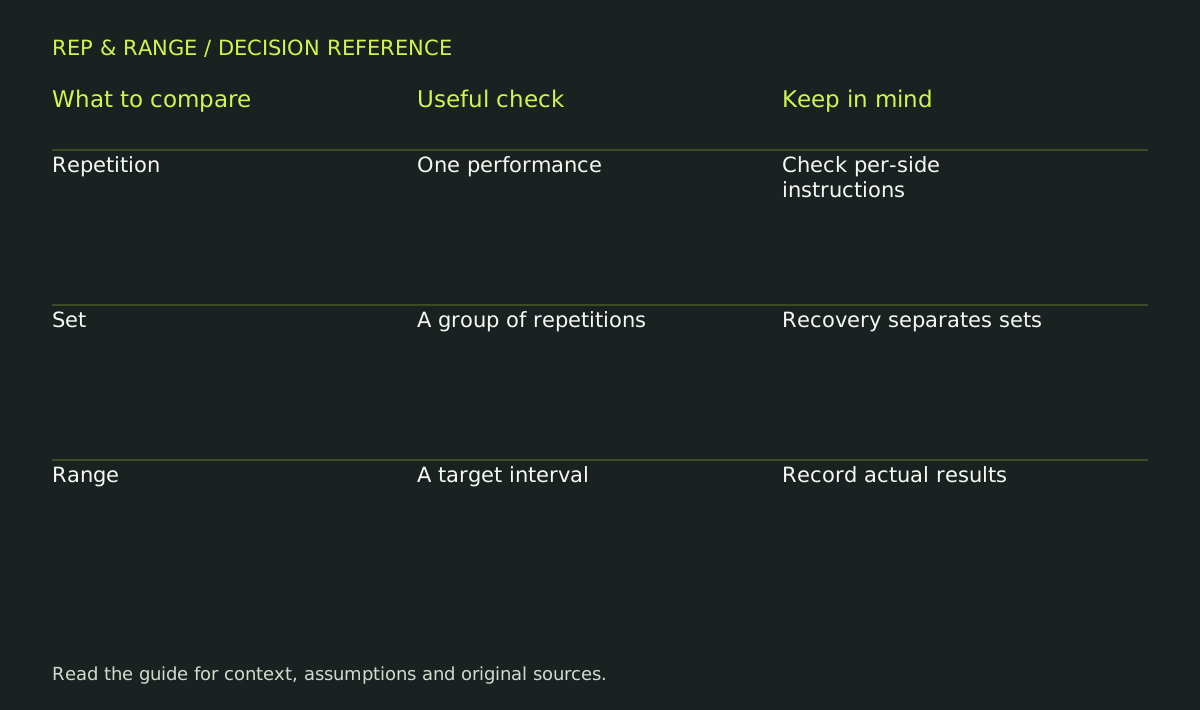
Compare the decision.
| What to compare | Useful check | Keep in mind |
|---|---|---|
| Repetition | One performance | Check per-side instructions |
| Set | A group of repetitions | Recovery separates sets |
| Range | A target interval | Record actual results |
AN ILLUSTRATIVE EXAMPLE
Three sets are three results
In an illustrative three-set entry, 10 + 9 + 8 equals 27 completed repetitions. The written range stays beside the results, and a timed hold uses seconds instead of being added to that repetition total.
Take this with you.
- Read the movement and unit
- Record each completed set
- Keep the load convention
Your questions, answered.
Is 3 × 10 thirty repetitions in one go?
No. It normally means three separate sets of ten repetitions, with recovery between sets. Check whether the plan specifies each side or a total.
Do warm-up sets count as working sets?
Record them separately so you can compare the intended working sets across sessions.
Does a rep range guarantee muscle growth?
No. The exercise, total work, resistance, effort, recovery and individual response also matter.