Progression means gradually adjusting a training demand as your capacity changes. More weight at every session is not the only useful outcome.
Establish a comparable task
Choose an exercise variation and a clear load convention. Keep the equipment, setup and intended movement range comparable. Ten repetitions on a different machine do not establish improvement over eight on the previous one.
Record what you actually completed. A steadier movement or a more manageable session can be useful information even when the load number stays the same.
Use one decision at a time
A simple editorial example is to hold the load steady while working within a repetition range. Once the intended sets are consistently comfortable and controlled, consider the smallest appropriate resistance increase available. This is an organising approach, not a clinically validated progression algorithm.
If the next increment is too large, repeat the current work or seek a suitable alternative. Buying a heavier set is not a requirement to progress through a first month of training.
Respect the cost of the change
Adding a working set increases the amount of work and the time needed. Shortening rest changes the task too. A different exercise can introduce new skill demands. These changes should be deliberate rather than added together simply because the previous session felt good.
Keep the rest of your week in view. A demanding work week, another sport or disrupted sleep can make repetition more appropriate than escalation.
Review a pattern rather than a deadline
Compare several similar sessions. A missed target once does not automatically call for a new programme; repeated difficulty may mean the load, volume, schedule or exercise needs adjustment.
Pain and persistent symptoms require a different decision from ordinary training effort. Do not use the next number in a spreadsheet to override a reason to stop and get individual advice.
Bring one useful question to the next session
Keep the task comparable. Change one variable deliberately. Review several sessions. Keep the guide beside your own record so you can see which part of the decision still needs information.
The worked example below is hypothetical. Replace its inputs with the quantities or circumstances you actually know; do not turn an illustration into a personal training or nutrition prescription.
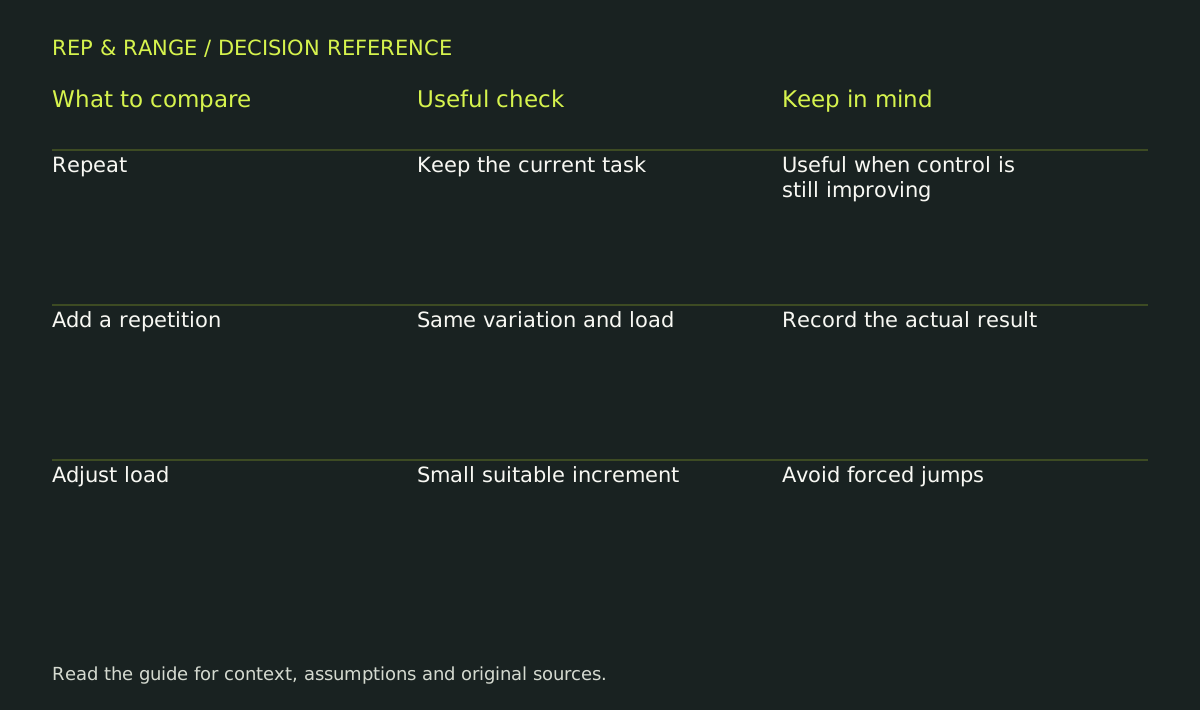
Compare the decision.
| What to compare | Useful check | Keep in mind |
|---|---|---|
| Repeat | Keep the current task | Useful when control is still improving |
| Add a repetition | Same variation and load | Record the actual result |
| Adjust load | Small suitable increment | Avoid forced jumps |
AN ILLUSTRATIVE EXAMPLE
Change one part of the record
An illustrative log progresses from 8 / 8 / 8 to 9 / 8 / 8 with the same variation and resistance. Only the first set has changed. That is clearer than adding weight, a set and a new exercise at the same time.
Take this with you.
- Keep the task comparable
- Change one variable deliberately
- Review several sessions
Your questions, answered.
Must I add weight every week?
No. Improvement is not guaranteed on a calendar schedule. Repeating manageable work and building consistency can be the appropriate choice.
Can I add repetitions instead?
Within a suitable plan, repetitions are one variable you can adjust. Keep the other details comparable and record the change.
What if the next dumbbell increment is too heavy?
Repeat your current work or choose a suitable smaller increment or variation. Do not force a load just to satisfy the log.