An intact band and a suitable setup come before its colour or advertised resistance. Follow the instructions for the exact band and any attachment.
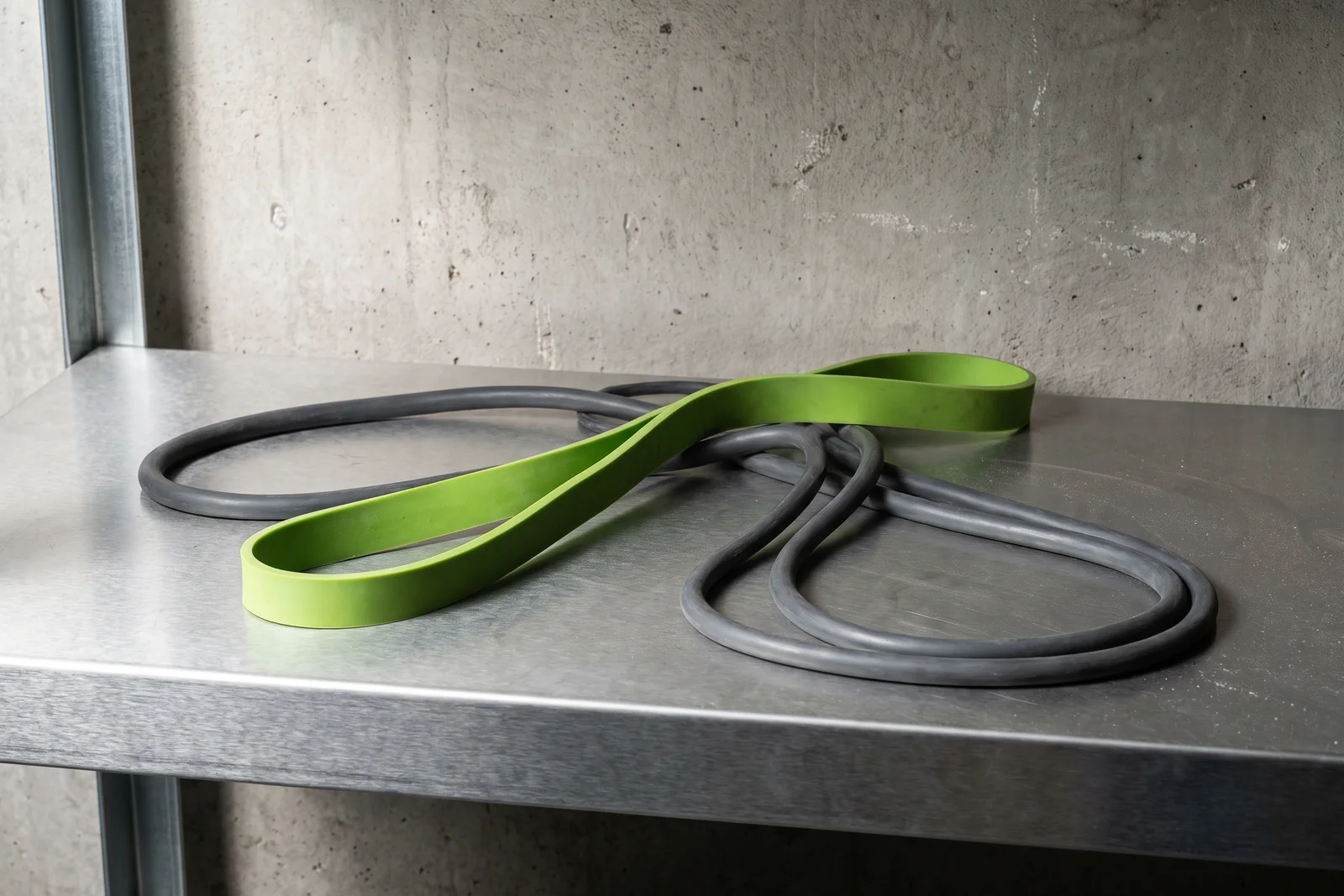
Check the item before use
Look along the band for visible damage, cuts, thinning or worn sections. Inspect handles and any attachment components as well. Retire a damaged item according to its manufacturer guidance rather than testing whether it can survive another session.
Materials vary. Check the product information if latex or another material is a concern. A fabric cover or a different colour does not by itself establish composition.
Treat the anchor as equipment
An attachment needs the right structure and installation. Read the original instructions and confirm that the anchor, support and band are designed to work together. Do not substitute a door handle or a movable chair for an approved setup.
Keep the possible recoil path clear and work within the stated stretch and use limits. Portable equipment still has mechanical limits.
Compare resistance carefully
Colour systems are specific to manufacturers and ranges. Two red bands can provide different resistance, and force changes with how much a band is stretched. A single number should be read with the supplier’s measurement conditions.
Record the exact band and setup if you want the log to be comparable. Moving further from an anchor or changing the starting length changes the task even when the band stays the same.
Store for the next session
Follow the product’s care and storage instructions. Inspect again after storage, and keep the band away from sharp contact points. Replacement is a practical maintenance decision, not a training setback.
If the required setup cannot be made appropriate in your room, choose a different movement or resistance tool. The home planner is meant to adapt to the equipment you can use safely.
Bring one useful question to the next session
Inspect band and attachments. Follow exact setup instructions. Record the band and starting length. Keep the guide beside your own record so you can see which part of the decision still needs information.
The worked example below is hypothetical. Replace its inputs with the quantities or circumstances you actually know; do not turn an illustration into a personal training or nutrition prescription.
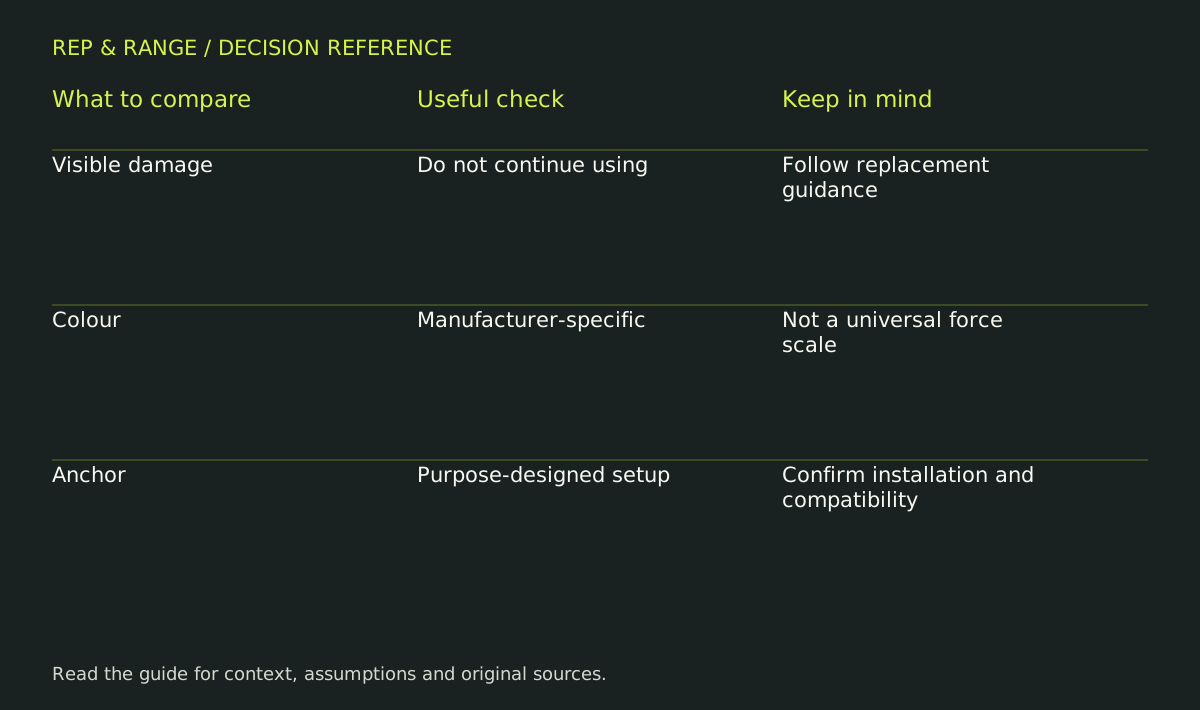
Compare the decision.
| What to compare | Useful check | Keep in mind |
|---|---|---|
| Visible damage | Do not continue using | Follow replacement guidance |
| Colour | Manufacturer-specific | Not a universal force scale |
| Anchor | Purpose-designed setup | Confirm installation and compatibility |
AN ILLUSTRATIVE EXAMPLE
Colour does not establish equivalence
Two hypothetical blue bands from different ranges need not have matching resistance. The log should identify the product and setup rather than recording only blue. No conversion can be inferred from the colour alone.
Take this with you.
- Inspect band and attachments
- Follow exact setup instructions
- Record the band and starting length
Your questions, answered.
Are all bands with the same colour equivalent?
No. Colours and resistance values depend on the manufacturer, range and stretch conditions.
Can I attach a band to any door handle?
No. Use an appropriate attachment and follow its installation instructions. A household handle is not automatically a suitable anchor.
What if the band has a small split?
Do not continue using a visibly damaged band. Follow the manufacturer’s replacement guidance.