Creatine has evidence for some repeated high-intensity activities. That is different from a promise that a tub will transform your training.
Match the claim to the activity
The NIH review describes benefits for repeated short bursts of intense effort. It is less useful as a broad claim about all endurance performance. Individual responses differ.
A supplement cannot make an inconsistent programme consistent. Before shopping, decide what question you are trying to answer about your training.
Do not let the formula name replace evidence
Creatine monohydrate is the most widely studied form. A different name or higher price does not establish a better outcome. Compare the evidence for the actual form, not the marketing around it.
We do not publish a universal personalised dose or stack. Medical conditions, medicines and individual circumstances should be considered with an appropriate health professional.
Read the tub as carefully as the headline
Check the ingredient, amount per serving, number of servings and any additional stimulants. Compare price on the same basis. A scoop is a manufacturer’s serving measure, not a universal weight.
The NIH notes that creatine can increase body weight through water retention. That short-term change is not itself proof of new muscle. Our site does not use generated pictures as evidence of real product testing.
Bring one useful question to the next session
Match the claim to evidence. Read the exact ingredient. Discuss individual suitability. Keep the guide beside your own record so you can see which part of the decision still needs information.
The worked example below is hypothetical. Replace its inputs with the quantities or circumstances you actually know; do not turn an illustration into a personal training or nutrition prescription.
Compare the decision.
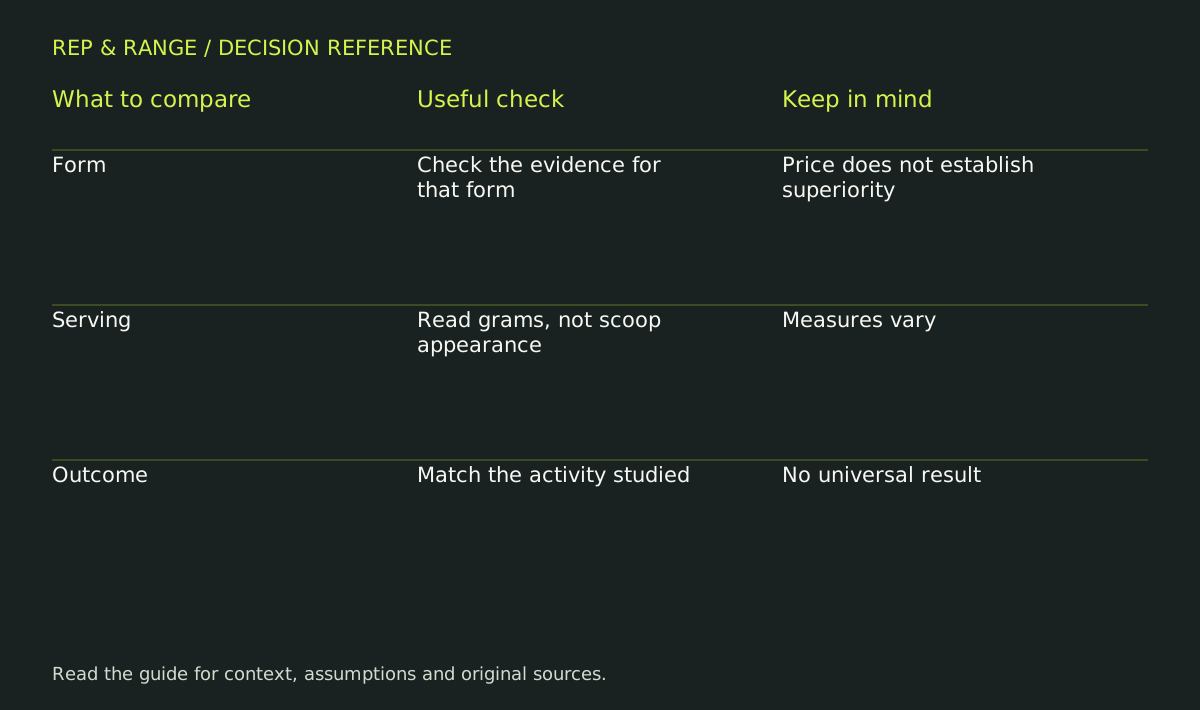
| What to compare | Useful check | Keep in mind |
|---|---|---|
| Form | Check the evidence for that form | Price does not establish superiority |
| Serving | Read grams, not scoop appearance | Measures vary |
| Outcome | Match the activity studied | No universal result |
AN ILLUSTRATIVE EXAMPLE
Compare a label before a tub price
A hypothetical 300 g container divided into labelled 5 g servings contains 60 servings. That is package arithmetic, not a recommended daily dose or proof of suitability. Check the actual ingredient and any additions separately.
Take this with you.
- Match the claim to evidence
- Read the exact ingredient
- Discuss individual suitability
Your questions, answered.
Is creatine HCl automatically better than monohydrate?
No. A claim about solubility or price is not proof of better training outcomes. Monohydrate has the larger evidence base.
Do I have to take creatine to use these workout plans?
No. The planner works independently of supplements.
How can I put this guide into practice?
Match the claim to evidence. Then use the related tool with the assumptions and limits described in the guide.